1.
y ¨ + 7 y ˙ + 10 y = u ˙ + 3 u
a)
Zero at t = 0
Laplace transform:
s 2 Y ( s ) + 7 s Y ( s ) + 10 Y ( s ) = s U ( s ) + 3 U ( s ) ⇒ Y ( s ) ( s 2 + 7 s + 10 ) = U ( s ) ( s + 3 )
⇒ U ( s ) Y ( s ) = s 2 + 7 s + 10 s + 3
b)
Unit step in laplace space is U ( s ) = s 1
Y ( s ) = s 2 + 7 s + 10 s + 3 ⋅ s 1
Final value theorem:
lim t → ∞ y ( t ) = lim s → 0 s Y ( s )
s Y ( s ) = s 2 + 7 s + 10 s + 3
lim s → 0 s 2 + 7 s + 10 s + 3 = 10 3
y ( ∞ ) = 0.3
c)
Y ( s ) = s ( s 2 + 7 s + 10 ) s + 3 = s ( s + 2 ) ( s + 5 ) s + 3
= s A + s + 2 B + s + 5 C
⇒ s + 3 = A ( s + 2 ) ( s + 5 ) + B s ( s + 5 ) + C s ( s + 2 )
⎩ ⎨ ⎧ s = 0 : 3 = A ⋅ 2 ⋅ 5 s = − 2 : 3 − 2 = B ⋅ ( − 2 ) ⋅ 3 s = − 5 : 3 − 5 = C ⋅ ( − 5 ) ⋅ ( − 3 ) ⇒ A = 10 3 ⇒ B = − 6 1 ⇒ C = − 15 2 ⇒ Y ( s ) = s 3/10 − s + 2 1/6 − s + 5 2/15 ⇒ y ( t ) = 10 3 − 6 1 e − 2 t − 15 2 e − 5 t , t ≥ 0
d)
t → ∞ lim y ( t ) = 10 3 − 6 1 ⋅ 0 − 15 2 ⋅ 0 = 10 3 Matches with final value theorem
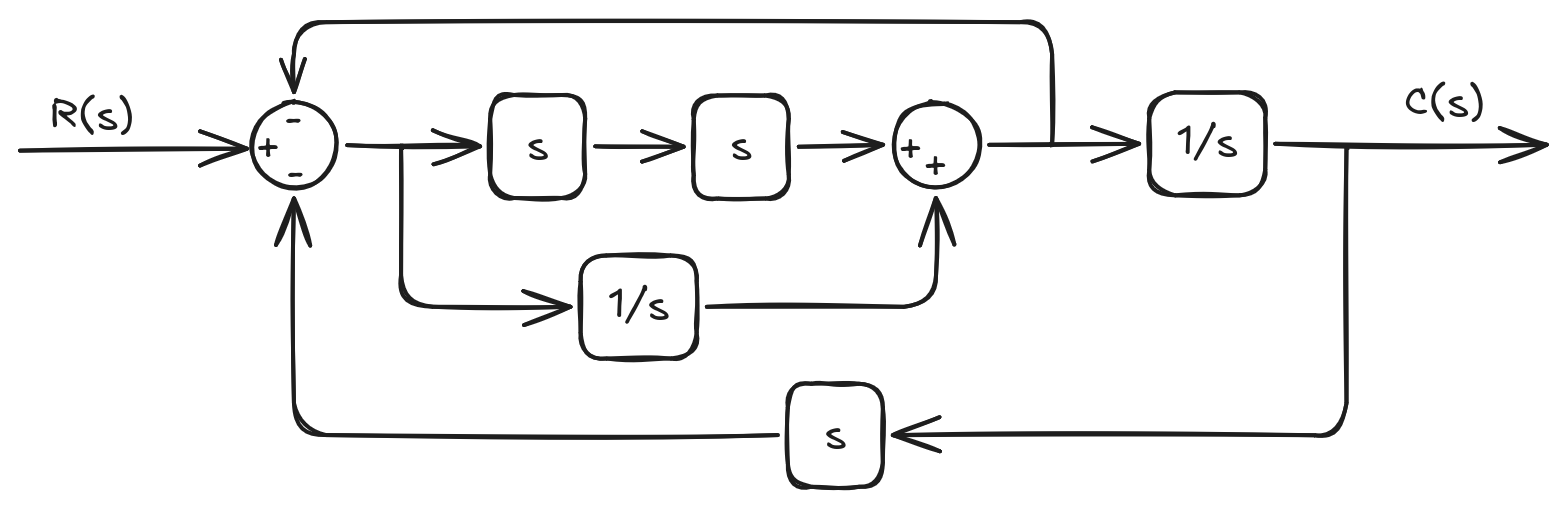
2.
a)
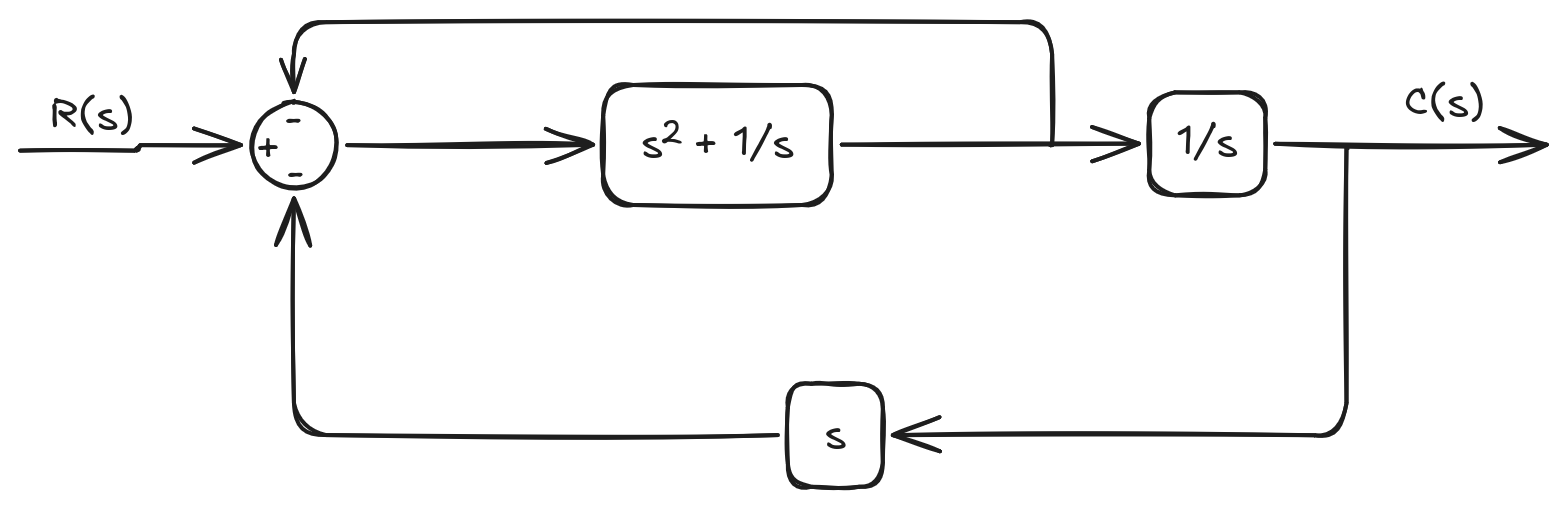
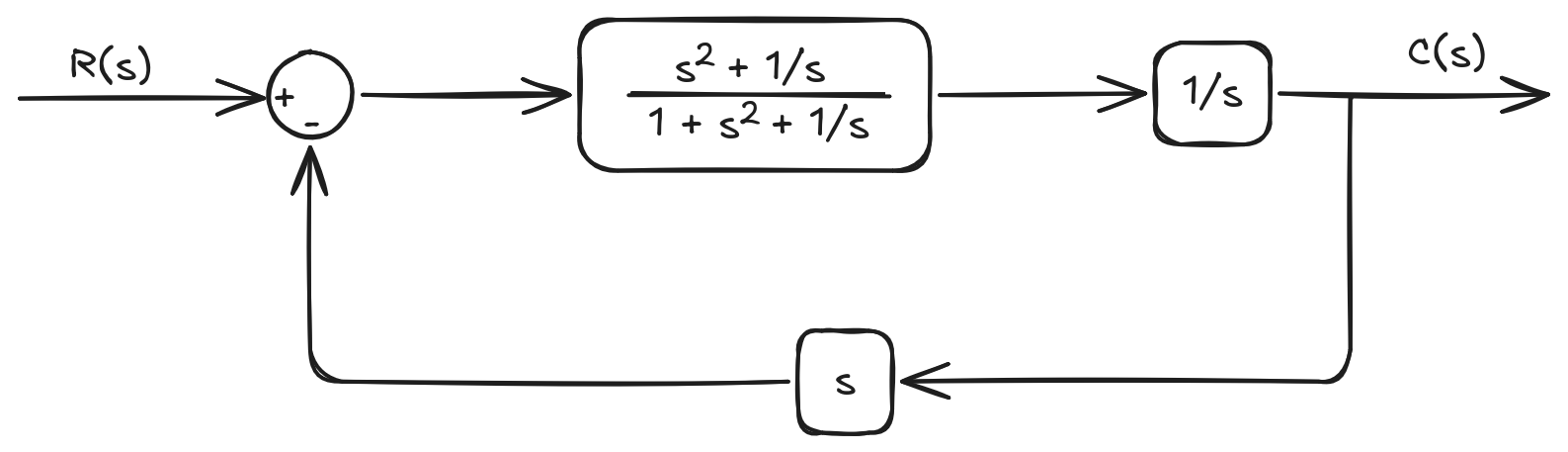
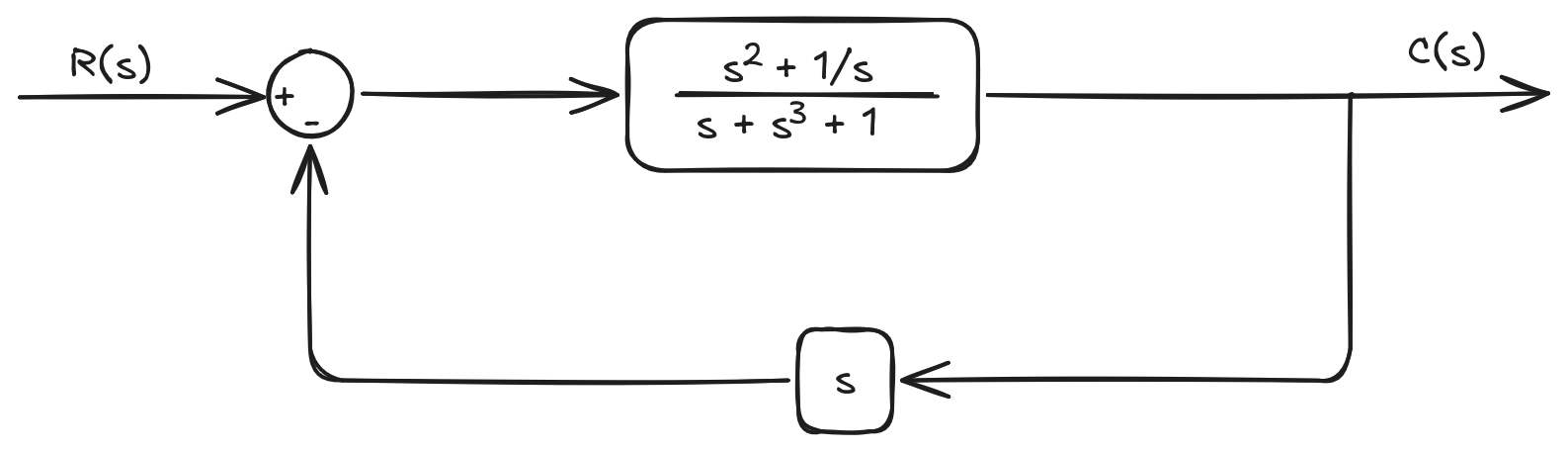
Simplified:
R ( s ) C ( s ) = 2 s 3 + s + 2 s 2 + s 1 = 2 s 4 + s 2 + 2 s s 3 + 1
b)
Characteristic equation:
2 s 4 + s 2 + 2 s = 0
⇒ s ( 2 s 3 + s + 2 ) = 0
Pole at s = 0
Poles from 2 s 3 + s + 2 = 0
Numeric solver on calculator gives root at s ≈ − 0.84
⇒ ( s + 0.84 ) ( 2 s 2 − 1.67 s + 2.39 ) = 0
solving for roots in 2 s 2 − 1.67 s + 2.39 = 0
s ≈ 0.42 ± 0.4 2 2 − 1.20 ≈ 0.42 ± 1.17 j
Since the system roots have positive real parts the system is Unstable .
3.
Open-loop transfer function:
G ( s ) = s ( s + 2 ) ( s + 3 ) K ( s + 20 )
Closed loop denominatior is 1 + G ( s )
1 + s ( s + 2 ) ( s + 3 ) K ( s + 20 ) = 0
⇒ s ( s + 2 ) ( s + 3 ) + K ( s + 20 ) = s 3 + 5 s 2 + ( 6 + K ) s + 20 K = 0
For the system to be stable, all poles from the cubic must have negative real parts. We get negative real parts if all coefficients are > 0
⎩ ⎨ ⎧ s 3 : s 2 : s 1 : s 0 : 1 > 0 5 > 0 6 + K > 0 20 K > 0 From that we get the lower limit K > 0
Find where K becomes to big and crosses over in to the right half-plane (s = jω
( jω ) 3 + 5 ( jω ) 2 + ( 6 + K ) ( jω ) + 20 K = 0
⇒ − j ω 3 − 5 ω 2 + j ( 6 + K ) ω + 20 K = 0
from the real part:
− 5 ω 2 + 20 K = 0 ⇒ K = 4 ω 2
imaginary part:
ω ( − ω 2 + 6 + K ) = 0
for ω = 0
− ω 2 + 6 + K = 0 ⇒ ω 2 = 6 + K
ω 2 K = 4 ω 2
K = 4 6 + K ⇒ 3 K = 6 ⇒ K = 2
which means the real part of the pole becomes positive, and the system becomes unstable, when K > 2
Answer: 0 < K < 2
4.
R 1 h 1 − h 2 = q 1
C 1 d t d h 1 = q − q 1
R 2 h 2 = q 2
C 2 d t d h 2 = q 1 − q 2
Laplace transform:
Q 1 ( s ) = R H 1 ( s ) − H 2 ( s )
C 1 s H 1 ( s ) = Q ( s ) − Q 1 ( s )
Q 2 ( s ) = R 2 H 2 ( s )
C 2 s H 2 ( s ) = Q 1 ( s ) − Q 2 ( s )
H 2 ( s ) = Q 2 ( s ) R 2 ⇒ C 2 s Q 2 ( s ) R 2 = Q 1 ( s ) − Q 2 ( s )
⇒ Q 1 ( s ) = Q 2 ( s ) [ C 2 R 2 s + 1 ]
From laplace-transformed ( 1 )
H 1 ( s ) = Q 1 ( s ) R 1 + H 2 ( s ) = Q 1 ( s ) R 1 + Q 2 ( s ) R 2
⇒ C 1 s [ R 1 Q 1 ( s ) + R 2 Q 2 ( s )] = Q ( s ) − Q 1 ( s )
⇒ Q ( s ) = Q 1 ( s ) [ C 1 R 1 s + 1 ] + Q 2 ( s ) C 1 s R 2
subsitute in Q 1 ( s ) = Q 2 ( s ) [ C 2 R 2 s + 1 ]
Q ( s ) = Q 2 ( s ) [( C 2 R 2 s + 1 ) ( C 1 R 1 s + 1 ) + C 1 R 2 s ]
⇒ Q ( s ) Q 2 ( s ) = R 1 C 1 R 2 C 2 s 2 + ( R 1 C 1 + R 2 C 2 + R 2 C 1 ) s + 1 1
Q.E.D.
5.
G ( s ) K = 30
G ( s ) = s 3 + 6 s 2 + 20 s K
a)
s = jω
G ( jω ) = ( jω ) 3 + 6 ( jω ) 2 + 20 jω K = − 6 ω 2 + jω ( 20 − ω 2 ) K
G ( jω ) = ( − 6 ω 2 ) 2 + ( ω ( 20 − ω 2 ) ) 2 K ( − 6 ω 2 − jω ( 20 − ω 2 ))
Crosses the real axis when Im [ G ( jω )] = 0
⇒ K ω ( 20 − ω 2 ) = 0
for ω = 0
20 − o m e g a 2 = 0 ⇒ ω = 20
Re [ G ( jω )] = ( − 6 ω 2 ) 2 + ( ω ( 20 − ω 2 ) ) 2 K ( − 6 ω 2 )
at ω = 20 20 − ω 2 = 20 − ( 20 ) 2 = 0
⇒ Re [ G ( j 20 )] = ( − 6 ( 20 ) 2 ) 2 K ( − 6 ( 20 ) 2 ) = − 6 ( 20 ) 2 K = − 120 K = − 120 30 = − 0.25
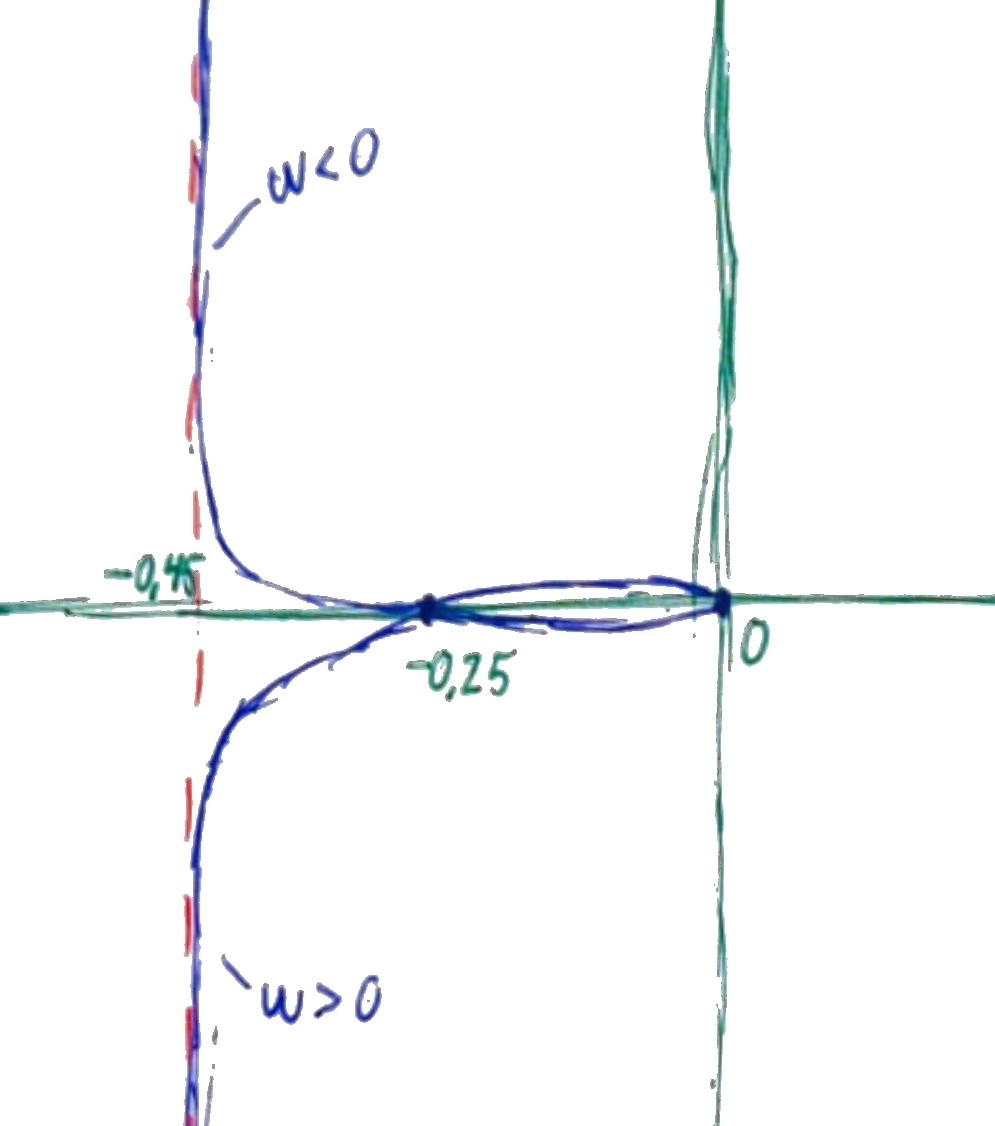
Crossing G ( jω ) = − 0.25 ω = 20 ≈ 4.472 rad/s ⇒ ∠ − 9 0 ∘
b)
G ( jω ) = − 36 ω 4 + ω 2 ( 20 − ω 2 ) 2 180 ω 2 − j 36 ω 4 + ω 2 ( 20 − ω 2 ) 2 30 ω ( 20 − ω 2 )
⇒ G ( jω ) = − 36 ω 2 + ( 20 − ω 2 ) 2 180 − j 36 ω 3 + ω ( 20 − ω 2 ) 2 30 ( 20 − ω 2 )
at ω → ∞ G ( j ∞ ) = 0
at ω → 0 + G ( j 0 + ) = − 2 0 2 180 − j ∞ = − 0.45 − j ∞
at ω → 0 − G ( j 0 − ) = − 0.45 + j ∞
c)
Z = N + P
Z
N ( − 1 , j 0 )
P
P
s 3 + 6 s 2 + 20 s = 0
⇒ s = 0
s 2 + 6 s + 20 = 0 ⇒ s = − 3 ± − 11
which means P = 0
For stable system no poles should lie in RHP wich means N = 0
N 1 − 1
From a) we have the crossing point:
G ( jω ) = − 120 K
Since G ( jω ) > − 1 K < 120 K < 120 K > 0
Answer: 0 < K < 120
6.
G ( s ) = ( s 2 + 13 s + 40 ) ( s 2 + 2 s + 5 ) K
a)
from s 2 + 13 s + 40 = 0
s = 2 − 13 ± ( 2 13 ) 2 − 40 = − 6.5 ± 1.5
s 1 = − 5 , s 2 = − 8
from s 2 + 2 s + 5 = 0
s = − 1 ± 1 − 5 = − 1 ± j 2
s 3 = − 1 + j 2 , s 4 = − 1 − j 2
Since s 3 s 4
b)
When poles have real parts closer to zero their exponetial decay becomes slower, eg. e − 1 t e − 8 t
7.
G ( s ) = s ( s + 2 ) ( s + 4 ) K ( s + 5 )
a)
K = 1 ⇒ G ( s ) = s ( s + 2 ) ( s + 4 ) s + 5
in Bode form:
G ( jω ) = jω ( jω + 2 ) ( jω + 4 ) jω + 5
normalised:
G ( jω ) = jω ( 1 + 2 jω ) ( 1 + 4 jω ) 1 + 5 jω
⎩ ⎨ ⎧ [ 1 ] : ( 1 + 5 jω ) 1 [ 2 ] : ( jω ) − 1 [ 3 ] : ( 1 + 2 jω ) − 1 [ 4 ] : ( 1 + 4 jω ) − 1 First order term with real root Root at origo First order term with real root First order term with real root Break points (1/ τ
⎩ ⎨ ⎧ [ 1 ] : [ 2 ] : [ 3 ] : [ 4 ] : ω = 5 − ω = 2 ω = 4 Behaves like (ω [ dB ]
⎩ ⎨ ⎧ [ 1 ] : [ 2 ] : [ 3 ] : [ 4 ] : + 20 log 10 ω − 20 log 10 ω − 20 log 10 ω − 20 log 10 ω Phase:
⎩ ⎨ ⎧ [ 1 ] : [ 2 ] : [ 3 ] : [ 4 ] : + 9 0 ∘ − 9 0 ∘ − 9 0 ∘ − 9 0 ∘ b)
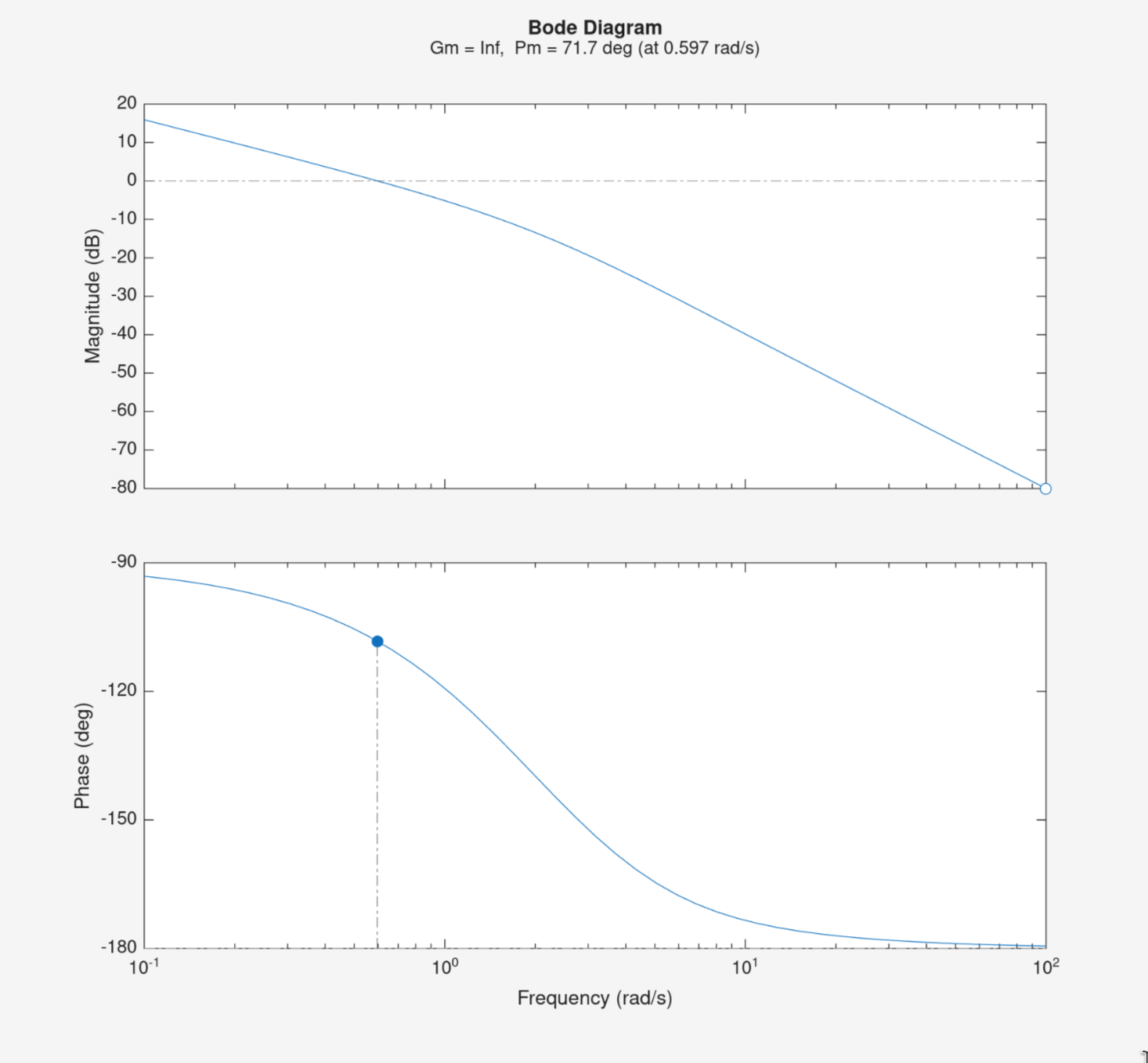
From the plot we get a phase margin of around 6 0 ∘
c)